Tuesday, April 9, 2013

Izmir to Istanbul, Saturday February 9th

So after a busy week of tours and cultural stops, our main duty for Saturday was getting to Istanbul with a group tour set up for Saturday afternoon, followed by a free evening and a free day on Sunday.  Our flight was a bit late leaving Izmir, but we got to Istanbul mid afternoon and got stuck in some of its reknowned traffic on our way into the city. 


The road from the airport took us along side the Sea of Marmara to where it joins the Bosphorus.  The first photo is that of some of the large ships waiting to go through the Bosphorus to the Black Sea as the waterway is one way depending on the time of the day. 


Our hotel the Yasmak Sultan http://hotelyasmaksultan.com/ is A on the map below (B and C were our stops for Monday) very near Sultanahmet, which has many of the cultural and historical sights we would visit.  Many of the sights we would see on Saturday and Sunday were within a mile of the Yasmak Sultan, a nice boutique hotel with a great rooftop bar and restaurant. 


As can be seen above, Sultanahment is surrounded on three sides by water, the Sea of Marmara, the Bosphorus on the East, and the Golden Horn to the North. 

Our first stop on our afternoon walking tour was Aye Sofya (Hagia Sophia), with its massive dome, dating from about 537 AD.  Starting out as a christian church, then becoming a mosque before becoming a museum following the founding of the Turkish republic (in 1923) in the '30's.  http://www.ayasofyamuzesi.gov.tr/en/


Here is the interior


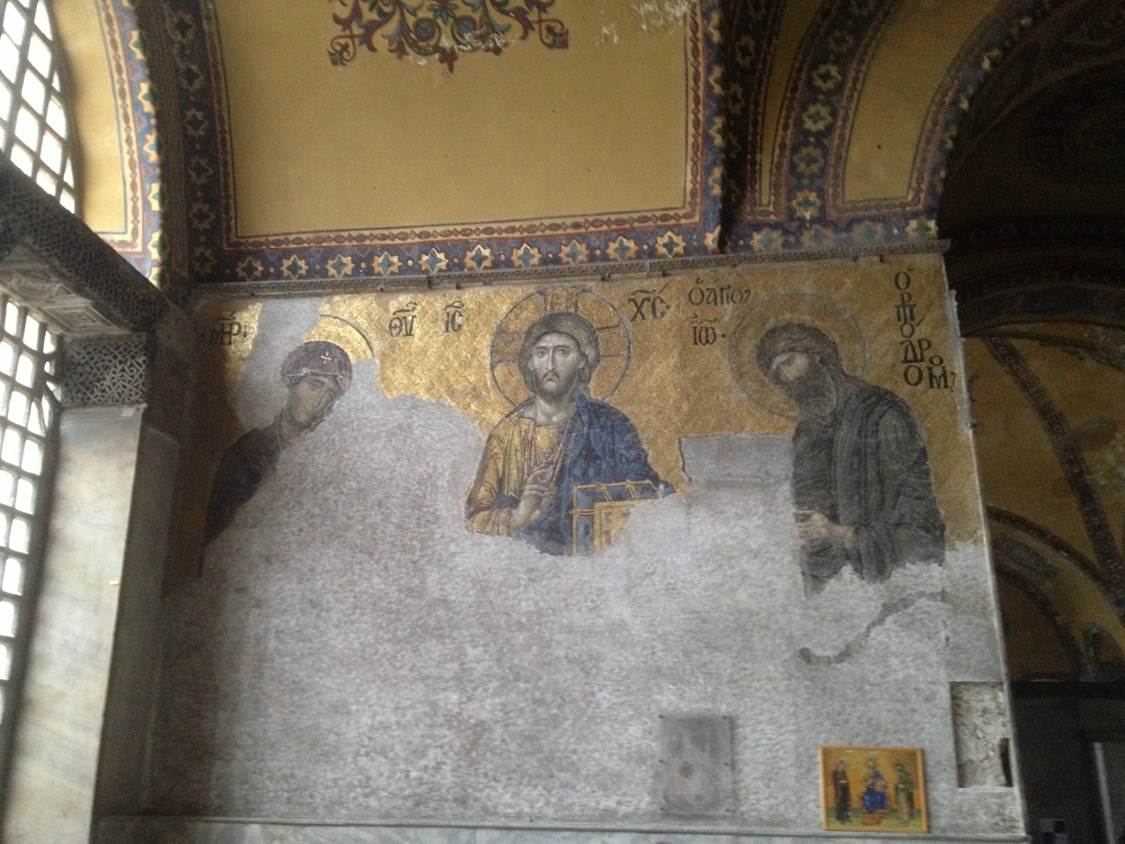
One of the many murals, this one from the early 14th century.

Our next stop was the Basilica Cistern, a columned cavern that stored water for many of the times the city was under seige. 

After the cistern, we visited the Grand and Spice Bazaars, both within a mile of the previous stops and the hotel.  I have to say while the bazaars have their own rich history (I believe the Spice Bazaar is from the 1600s), I found them interesting but a bit touristy -- crowded, crazy labryinth-like indoor malls.     


The very similar looking Spice bazaar, basically the same as the Grand Bazaar except more of a foodie feel to it with part of it outdoors. 


We capped off the evening with a dinner nearby the hotel.  I had wanted to venture North of the Golden Horn into the more modern Beyoglu section of the city for some night life (some of the crew made it to feast which included belly dancing), but it was a cold rainy night and staying close by seemed like the better call.  We ate a nice restaurant called Pasazade recommended by my guide book Lonely Planet (overall was pretty good) right near the hotel.  Can't remember what I ate -- I'm thinking a lamb stew, but it was reasonable.  Grabbed a nightcap at nearby Scottish sports bar (when in Rome, or Istanbul as it were), but wanted to be well rested for the busy day of touring ahead. 

Tuesday, April 2, 2013

Kirazli to Izmir -- February 8th

So Friday morning we all gathered back at the tea house and said good-bye to our hosts.  Turkish men typically greet and say good-bye to each other with a kiss on the cheek, which Faruk had done when he'd said good night the previous evening and bid farwell to Scott, Brian and me the same way.  At one point during the evening Faruk paused and looked at the three of us and asked rhetorically, "Tonight, we have good time didn't we?"  We certainly did. 

We had a bit of a drive that morning heading north along the Aegean coast to the small town of Seferihisar, mostly in the rain though it let up long enough for me to snap a couple photos. 

We had one of our more comical moments that morning.  As Larry had predicted there was tight turn in the small town of Seferihisar that our bus couldn't navigate and we had to walk about a half mile to the Baltali goat farm.  We passed a burial en route and were passed in turn by a white Mercedes with a woman in the back seat with blond hair, who turned out to be our host, Funda Ozer Baltali. 
This was not your average goat farm, in as much it was a large modern facility with several hundred goats and a processing plant on site not to mention it was owned by a woman.  We actually didn't go inside the barns for biosecurity reasons but had a lively discussion followed by tea and refreshmants before a quick look inside the processing plant.  We had to walk back to the bus from the farm even though our host explained to our bus driver a different route to the farm, but the bus driver would have none of it.  At another point in the trip our tempermental bus driver shut off use of the bathroom because he claimed we'd clogged it with excessive disposal of toilet paper.  [At the risk of TMI, throughout the country, the plumbing is fragile so in many places toilet paper goes into a waste can instead of the toilet, and evidently the same goes for the bus toilets as well.] 


The corner the bus couldn't make
We had about a half hour drive to the city of Izmir, the third largest in Turkey and home of Ege University, which boasts rhe largest ag. faculty in Turkey, where we would spend the afternoon.  We had a great lunch in the faculty dining room and then two presentations on Ege and ag. education and the second on the Central Anatolia Project (CAP). 

The CAP was a subject we wanted to learn about (though we didn't travel to that region) as it's basically a giant irrigation project to boost agricultural productivity in the arid regions of the Central and Southeast Turkey.  We saw a state-produced promotional video on the project, touting its merits, though the environmental underpinnings of the project, given the crops (like cotton) they intend to produce in that region are questionable.  Clearly the Ege faculty didn't want to say a lot on the topic.   In general we got mixed reviews from industry people about the role of ag. universities in Turkey.  

We were going to check out some university greenhouses, but the weather was terrible and it was difficult to navigate the campus in our bus late on a Friday afternoon, so it was off to the Aksan hotel, which was in a bit of sketchy part of town.  At the very bottom is a view from the rooftop of the hotel in Izmir.     

Food magically appeared from these windows at the Ege University faculty dining room
Ege's ag. quad
Rolling out the red carpet for Greg Comeau
Dr. Hilda Ilbi, Vice Dean of the agriculture faculty with Timucin, our translator 

Back in class


Wednesday, March 27, 2013

Kusadasi to Kirazli, Thursday February 7th (Ephesus and Homestays)

Looking back 6 weeks later as I write this, Thursday was probably the most memorable day in our trip, with the stop at Ephesus and our homestays, even more so than the days in Istanbul. 

We started out at Ephesus, and I'm glad it wasn't the first ancient site we visited as it was expansive and well preserved and might have made the previous ones seem less impressive by comparison.  The historical significance hit me when our guides reminded us of that this is the Ephesus referred to in the Bible as in St. Paul's letter to the Ephesians.

Now 5km from the coast, in Greco-Roman times it was a seaside city of  250,000.  I won't attempt a pithy summary of the city's history, and will let the pictures do the talking.  Of course before we entered the north gate of the city, there were a series of souvenir stands, and I appreciated the honesty of this merchant. 

Just inside the north gate to the city looking toward the sea and the rest of the city down below

The library of Celcus


looking back up Curetes Way

library of Celcus


Panoramic shot of the library with the gate to the lower agora (outdoor courtyard) to the right.  Classmate Andrew Wright showed me how to take panoramic photos and then I couldn't stop. 

Lower agora on other side of gate next to library

Ephesus' theater -- that's actually me on the stage.  The battery ran out on my phone (taking too many panoramic pictures) so I got this one from Andrew

So once we all caught our breath from seeing Ephesus, after lunch we went to a small olive processing company called Sirince, outside the nearby town of Selcuk.  One of the things I enjoyed (I didn't even notice it at the time) is that they had the multi-blue, "evil eye" on many of the machines to ward off mechanical failure.  One is visible in the photo below on the far left edge of the photo at the lower left edge of the "E" on the machine. 

We were brought to the plant by the man who had arranged our home stays, and following that tour we circled back to the small village of Kirazli not too far from where we stayed the previous evening in Kusadasi.


We certainly turned a few heads when the motorcoach pulled into town and 30 Americans spilled out.  Our host, Yalcin, took us to his small olive nursery which was right in the village and talked to us about how he was trying to grow new trees by grafting new high producing varieties onto native rootstock.


After the tour of his tree nursery we took over (literally) the local tea house for a discussion of olive production and marketing.  Nothing like kicking half the male population out of the tea house to make a good impression.  But the truth was the entire class was in a bit of a funk as we were looking ahead to the homestays as most of us were nervous and none of us knew what to expect. 

Evan Scheidel outside the Kirizli tea house
Our host had arranged for about a dozen families to host our class in groups of twos and threes, and so about five in the afternoon, people started showing up and leading multiple groups off to their homestays.  We were staying only stones throw from the tea house in the middle of town, and so along with Scott Keyes and Brian Hall, we soon met Faruk and his family.  

I'd managed to learn a little bit of Turkish so Brian and Scott figured they were all set staying with me.  My Turkish came in very handy but not for the reasons I expected.  For one thing Faruk and his 21 year old daughter who was home from university in Ankara both knew English pretty well.  Faruk is a talented artisan, retired from selling carvings and drawings to tourists in Kusadasi, and was now growing some olives, oranges and cherries.  His daughter had already spent a semester in China.  Faruk's wife didn't speak English nor did his grown son, who appeared to have a disability. 

They couldn't have been nicer or more welcoming to us and we all knew right away, it was going to be fine.  We had a great time talking about where we were from and what we did, and soon after our arrival, we had brought out the computer and were showing on google earth our homes, and even zoomed in on Faruk's house and beach house near Kusadasi (see below).  Brian and I had brought picture books as gifts for our host (Scott had brought maple syrup) and we spent a good deal of time going through the pictures.  We really started having a good time when we were comfortable enough to start busting chops -- not surprisingly, I was the initial target.  Brian is an accomplished hunter, which Faruk was very interested in, and he even brought out his gun to show him.  Faruk's son was very wary of us at first, but he finally came in and joined us and was pouring over the picture books, especially the one Brian brought featuring Adirondack wildlife.


They fed us a wonderful dinner with mountains of food and once we had retired to the living room to visit after dinner, they gave us Turkish coffee, fruit (where I discovered the walnut fig combo) followed by tea.  Faruk's wife and daughter would not let their father's cup stay empty for long.  When I said my Turkish came in handy, it was more the novelty/icebreaker aspect of it -- they got a kick out of my handful of Turkish phrases with what seemed to be a mixture of appreciation and amusement.  They invited two relatives over (according to class members this happened at a number of places where neighbors and relatives were invited to view the Americans) including a 10 year old niece who wanted to try out her English on us.  She was too shy to say a word, so I suggested I would try Turkish on her and when I asked if she knew English (in Turkish), everyone doubled over with laughter. 

We found out the next day that many host families didn't speak any English, but overall, most of the visits went fine even if many did include a lot of smiling and pointing at pictures.  Google translate and dictionaries came in handy as well though I would advise being cautious using google translate, as some appear to be rough translations.   

at dinner with Brian, Faruk and Scott
It had been a wonderful stay, and as we said goodbye that next morning driving away on the bus, we knew none of us would ever forget our 18 hours in Kirizli. 


Tuesday, March 26, 2013

Pamukkale to Kusadasi -- Wednesday February 6th

Waking up in Pamukkale, we began the day right outside the back door of our hotel, where we could see the Travertines, which look like white cliffs (and no guarantees on my Wikipedia-referenced geologic explanation).  Travertine is a form of limestone formed by a process of rapid precipitation of calcium carbonate, often at the mouth of a hot spring or in a limestone cave.  http://en.wikipedia.org/wiki/Travertine  As we found out that was certainly the case here, with the hot springs coming through the middle of the ancient city of Heiropolis, which sits atop the white cliffs.  Interesting to note that until about 10 years ago there were hotels situated right in the middle of the hot springs which were ruining the Tavertines, turning them brown (shocking that hotels sitting within the hot springs, actually using the heated water in the hotel, would have an adverse effect) and following a contentious lawsuit, were taken down. 


Heirpolis itself is a sprawling historical site, as we would find out later, not the best preserved.  Like many sites it had layers of history with the picture below showing city gates to the main street from both Roman, and post-Roman times. 

In front of the the gymnasium which also houses the museum which we didn't have time for. 
All of which overlooked the Tavertines and the Mountains to the South and West. 
with Jenny Crist and Scott Keyes
After Heiropolis, we headed back to Denizli, where fortunately the air was better.  We saw a nut roasting and packaging company called Altintop (though most of the hazelnuts are grown further north and east near the Black Sea).  
Following Altintop, we headed due west toward the Aegean coast to Aydin, where we visited Yateks figs, which packaged figs (not surprisingly) but also copacked some other fruit from a Spanish company as the labor cost was much cheaper in Turkey. 

Black light aids workers (all women) who look for a particular kind of toxin (like alphatoxin in corn). 


The figs are handpacked and as we would find out a day or two later, delicious with walnuts.  Following the tour we got a very interesting discussion about fig production, which is from an evolutionary standpoint, is an ancient fruit, but which retains some advantages over many of the fruits we cultivate here in the U.S. 

After Yatek's Figs we travelled to a nearby winery called Sevilen Magnesia Winery.  A large, modern facility, it was interesting visiting a winery in a Muslim country.  The winery appeared to have a marriage of convenience with the government, which taxes their product heavily.  
winery foyer

lots of stainless steel tanks
After Aydin, we headed the rest of the way to Aegean seaside city of Kusadasi where we enjoyed wine compliments of our hosts at Sevilen.  It was a common theme during the trip in that at each stop today we received gifts, hazelnuts from Altintop, figs and raisins from Yateks, which had also had held back some production so that we could see their plant (somewhat offseason) while operating.